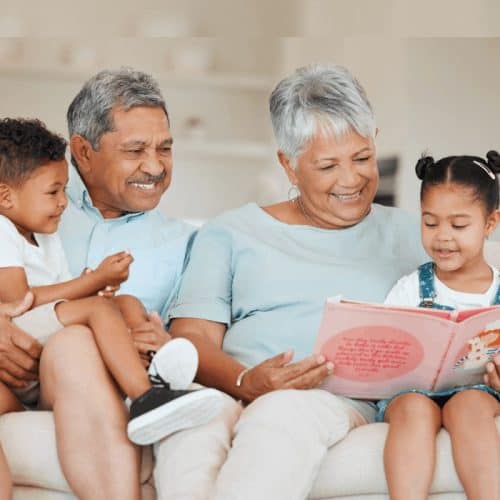
We all have different ways of giving and receiving love, and those preferences can reveal a great deal about us.
You may be the type who expresses love with words, telling people you care about them or writing carefully worded messages when someone needs encouragement. Or maybe you prefer physical affection, such as hugging and holding hands, to show how you feel. Others express love through gifts: flowers, chosen birthday presents, or a surprise spa day. For many, love dwells in shared moments or in quiet, selfless acts that make someone else’s life easier.
How we express our love for others and how we prefer to receive love are known as our love languages, a term popularized in a self-help book from the 1990s. We may speak one love language when we give love and another when we receive it. Depending on our personality, our expressions of love can be far-reaching and obvious or small and subtle.
Estate planning is a love language all its own that can communicate care not only through gifts of money and property but also through the act of planning for what will eventually happen to us. It is a way of showing love to the people who depend on us by creating clarity and support, so they are not left guessing or scrambling when we are no longer here.
The phrase love language entered the cultural lexicon in 1992 with the publication of The Five Love Languages by Dr. Gary Chapman. Chapman’s basic idea is simple: People give and receive love in five ways:
His book came when American culture was encouraging more emotional transparency and self-expression. I feel the book remains applicable. It also overlapped with and helped fuel a broader cultural movement toward approachable psychology for ordinary readers, later seen in works such as Men Are from Mars, Women Are from Venus.
Over the past three decades, different love languages have moved far beyond their original relationship-counseling context. It has become shorthand for how we show care, responsibility, and emotional investment in the people who matter most to us—all themes that also fit naturally with estate planning.
However, while self-help, emotional openness, and the love-language framework now seem part of a ubiquitous cultural movement toward emotional fluency, talking about death and estate planning continues to be substantially taboo. Most people still avoid discussing these topics:
Even emotionally fluent individuals and families often avoid end-of-life conversations because they may feel morbid or triggering. A 2025 Pew Research survey, for example, found that parents and their adult children often avoid discussing topics such as medical decision-making, long-term living arrangements, and future burial plans.
Another 2025 study found that death and estate planning ranked second among the most difficult topics to discuss with family. The same number of respondents (25 percent) rated end-of-life conversations as uncomfortable as discussions about mental health.
We may have become more expressive about our feelings in life, but not about what happens after life.
Admitting that you may someday lose your independence clashes with our cultural emphasis on self-determination and autonomy, forcing us to confront a potential loss of control situation, which our culture is uniquely uncomfortable with.
Emotional transparency has its limits. Even though openness is demonstrably higher than ever in our culture, estate planning rates remain frozen in time and, by some measures, are lower than ever.
The irony is that estate planning can communicate care more powerfully than many of the love languages we use each day. Consider how each love language may show up in your estate plan.
Estate planning, with its legalese and technical terminology, can seem unapproachable. At its simplest, an estate plan is a set of documents that conveys meaning and intention. Words of affirmation result when someone
Estate planning parallel: People want to feel seen, valued, and emotionally safe. Estate planning gives your loved ones the reassurance of knowing exactly what you want and why. It removes ambiguity, the emotional friction that often leads to hurt or conflict and shows them they are appreciated and protected.
It is not a stretch to say that estate planning is an act of service built on performing helpful, thoughtful deeds, such as:
Estate planning parallel: People feel loved when someone reduces their load, especially during moments of stress and uncertainty. A well-designed estate plan quietly shoulders future legal, financial, and emotional burdens so your family need not carry them in the hardest moments.
An estate plan is not merely about money and gifts, but it involves a strong element of gift-giving. Here, the giver is leaving their most valuable assets and prized possessions to family, friends, and charities, reinforcing relationships and building emotional bonds with tangible items. The love language of gift-giving can be seen in
Estate planning parallel: People want to feel remembered and cherished. Planning turns inheritance into meaning and elevates gifts to something more than material transfer. Whether it is money, a family heirloom, or a charitable gift, it communicates “this mattered to me, and so do you.” The way assets pass under a solid estate plan—clearly, legally, and efficiently—is also its own gift.
Quality time is about presence and togetherness. Think of moments from your life with the greatest meaning. They were probably not spent alone; rather, you shared them with others, which is usually why they mean so much. Our time is limited, and how we spend it speaks volumes about what (and whom) we care about. Quality time in an estate plan looks like
Estate planning parallel: People want to feel connected and prioritized. A well-organized estate plan gives your loved ones the time and emotional space they need to console, remember, and be together without distraction.
Physical contact builds and reinforces emotional bonds. Psychologically, it represents protection, security, and comfort, which most people need to feel loved. When you are physically incapacitated or gone, estate planning can play a deeply symbolic role that reinforces the power of human touch. Even when you are not physically present, estate planning mirrors the love language of physical touch through
Estate planning parallel: Planning provides protection at a moment of great vulnerability. Medical directives, care instructions, and trusted decision-makers form a protective boundary around your loved ones, helping them feel safe and grounded and conveying an emotional steadiness they can feel even in your absence.
Dr. Chapman and his work on the five love languages gave us a powerful framework to discuss what can sometimes be hard to put into words. He made emotions more approachable and relationships more manageable in a format that has remained relevant for 30 years since publication.
Your estate plan can serve the same role by staying relevant long after it is created.
We can help translate the love languages of the people who matter most to you into the language of estate planning with documents that reflect your wishes, protect your legacy, and communicate care in a way that your loved ones will feel for years to come. Call the attorneys at Altman & Associates at (301) 468-3220 or through the website at altmanassociates.net.